Category: Managed IT Services

  • Cut Through the Hype: Must-Have Solutions for Digital Transformation

    Cut Through the Hype: Must-Have Solutions for Digital Transformation

    Digital transformation isn’t about tearing everything down and starting over. It’s about using modern tools to run your business better, faster and smarter. Whether it’s managing inventory, handling customer queries or tracking performance, the goal is simple: Make things easier and more efficient.

    But the moment you start exploring digital tools, the noise hits. Endless platforms, big promises and zero clarity on what actually meets your business needs. You may feel stuck before you even begin.

    Here’s the truth: You don’t need everything — you need the right things. In this blog post, we’ll cut through the hype and show you the tools that truly make a difference.

    Essential solutions that move the needle

    Focus on practical tools that have a real impact. These are the ones that help you work smarter without burning out or blowing your budget.

    Cloud-based systems for flexibility and remote access

    Cloud tools let you access your data and systems from anywhere. No more being tied to one device or location. Whether you’re working from home, traveling or managing a remote team, cloud platforms keep everything running smoothly. They also make updates and backups automatic, so you don’t have to worry about losing important files.

    Automation tools to save time on repetitive tasks

    Think of all the small tasks you do every day, like sending reminders, updating spreadsheets and replying to routine emails. Automation tools handle these for you. They free up your time so you can focus on work that needs your attention. You’ll get more done without working longer hours.

    Cybersecurity basics to protect your business

    You might not have a full security team, but getting the basics right is critical. Strong passwords, two-factor authentication and regular backups are a good start, but real protection often needs expert oversight. This is where working with a trusted IT partner can make all the difference.

    Collaboration platforms to keep teams connected

    Whether your team is remote or in-office, collaboration tools help everyone stay on the same page. Shared documents, chat channels and video calls make communication faster and clearer. No more endless email threads or missed updates.

    Data tools to make smarter decisions

    You already have data in the form of sales numbers, customer feedback, website traffic and more. The right tools bring order to the chaos. They allow you to spot trends, understand what’s working and make decisions based on facts, not guesses.

    These tools aren’t just shiny new solutions. They’re the ones that help you work better and ignite your growth potential. Now, let’s discuss how to select and utilize them without the stress.

    How to cut through the noise

    Even the best tools won’t help if they’re not set up correctly or don’t fit your business needs. That’s where we make things simple. Instead of guessing or juggling solutions on your own, here’s what we’ll do for you:

    • We recommend only what fits your goals.
    • We set up and support the tools so they work for you.
    • We keep things simple and stress-free.
    • We help you grow without wasting time or money.

    You don’t need to be a tech expert. You just need the right partner. Digital transformation is achievable with the right guidance and support. Schedule your discovery call and let’s get started.

  • Cybersecurity Blind Spots: What Business Leaders Often Miss

    Cybersecurity Blind Spots: What Business Leaders Often Miss

    Every business leader knows how critical cybersecurity is. But often what they fail to see are the dangers lurking in plain sight.

    These aren’t screaming, headline-grabbing threats. They’re small but preventable ones like a missed software update, forgotten accounts or unchecked backups.

    They may not seem like a dangerous gap, but they leave the door open to cyberattacks. In this blog, we’ll walk you through the most common cybersecurity gaps and offer practical ways to address them before they become a problem.

    The gaps you don’t see (but hackers do)

    Here are some of the most common blind spots and why they matter more than you realize:

    Unpatched systems and software

    Hackers closely monitor patch cycles, and they know which vulnerabilities can be exploited if left unpatched. Every missed update is an open invitation.

    Fix: Automate your patch management to ensure critical updates never slip through the cracks and set alerts for any systems that fall behind.

    Shadow IT and rogue devices

    Your employees intentionally or unintentionally download malicious apps or connect compromised devices to the company network. Every unapproved access is a potential risk for your business. These apps or Trojans can stay dormant and unnoticed, until they wreak havoc later.

    Fix: Devise a clear policy for app and device usage. Regularly scan your network to spot unknown or unmanaged endpoints.

    Weak or misconfigured access controls

    Too much of anything is a bad thing, especially when one person has too many access permissions. Hackers can exploit over-permissive accounts.

    Fix: Apply the principle of least privilege. Give employees access only to what they truly need. Make multifactor authentication mandatory for all and regularly review permissions to add or remove access as roles change.

    Outdated security tools

    A security tool isn’t a one-time solution. Threats are constantly evolving. That’s why your antivirus tools, endpoint protection systems and intrusion detection platforms all need to be updated regularly. They should be able to respond to today’s threats, not yesterday’s.

    Fix: Review your security stacks periodically to ensure everything is up to date. If a tool doesn’t fit your needs, replace it before it becomes a liability.

    Inactive or orphaned accounts

    When employees leave, their credentials often remain functional. For cybercriminals, these accounts are a gold mine because they’re valid, unnoticed and unmonitored.

    Fix: Deploy an automated system to offboard employees quickly after they leave the company.

    Firewall and network misconfiguration

    Your firewall’s protection depends on how its rules and permissions are managed. Old or temporary settings can leave gaps in your defenses.

    Fix: Thoroughly audit your firewall and network rules. Always document every change and remove what’s no longer needed.

    Backups without verification

    Many businesses mistakenly believe that backing up means they’re prepared for any disaster. In reality, backups aren’t a guaranteed safety net. Too often, companies discover too late that their backups are corrupt, incomplete or impossible to restore.

    Fix: Test your backups routinely. Run a full restore exercise at least once a quarter. It’s also important to store backups securely, offline or in immutable storage to prevent tampering.

    Missing security monitoring

    You can’t protect what you can’t see. A surprising number of businesses lack centralized visibility over their systems. Instead, they rely on individual alerts or security logs that no one reviews.

    Fix: Partner with an experienced IT service provider if your goal is to detect early, respond fast and minimize damage.

    Compliance gaps

    Compliance frameworks like GDPR, HIPAA or PCI-DSS are critical for businesses today. They provide a roadmap for strong security practices, but many organizations underestimate the complexity of the documentation and evidence required.

    Fix: Conduct regular reviews to ensure you remain compliant.

    How We Can Help

    Identifying blind spots is only the beginning. The real value lies in fixing them quickly without disrupting your operations.

    That’s where we come in. We can help you pinpoint these critical vulnerabilities and help you close them with precision. We bring the clarity, structure and discipline needed to make your security posture stronger.

    Let’s start with one small step: Request a tech health check and see exactly where your defenses stand.

  • The Hidden Costs of Ignoring Tech Health

    The Hidden Costs of Ignoring Tech Health

    Your business runs on technology, but when was the last time you checked in on its health?

    Too often, IT maintenance is ignored until something breaks. The reality? Neglecting your tech environment doesn’t just invite risk. It can cost you time, money and customer trust.

    In this blog, we’ll uncover the true price of “doing nothing” about tech health. From financial losses and security nightmares to operational setbacks and brand damage, the stakes are higher than ever. Let’s explore why proactive IT management is the smartest investment your organization can make.

    The high price of inaction

    Neglecting the health of your technology ecosystem isn’t just a minor oversight; it can have serious, far-reaching consequences. Below, we break down the many risks your organization could face when IT issues go unaddressed.

    Financial costs

    • Downtime and lost revenue: Unidentified vulnerabilities can lead to system outages, costing thousands per hour in lost productivity and sales.
    • Ransomware and breach costs: Blind spots often become entry points for cyberattacks. The average cost of a data breach is now in the millions.
    • Compliance penalties: Missing controls or documentation can result in fines for non-compliance with HIPAA, GDPR or other regulations.
    • Recovery and remediation expenses: Emergency fixes, forensic investigations and PR damage control are far more expensive than proactive maintenance.

    Security risks

    • Data loss or theft: Unsecured endpoints, outdated software or misconfigured access controls can expose sensitive data.
    • Unauthorized access: Orphaned accounts or unmonitored devices can be exploited by attackers or insider threats.
    • Malware propagation: Vulnerable systems can become launchpads for malware spreading across your network.

    Operational and strategic impact

    • Reduced performance: Inefficient systems and outdated hardware and software slow down teams and frustrate users.
    • Missed opportunities: Lack of visibility can prevent strategic IT planning, delaying innovation or digital transformation.
    • Poor decision-making: Without accurate data on your IT environment, leadership may make misinformed investments or overlook critical risks.

    Reputation damage

    • Loss of client trust: A breach or prolonged outage can erode customer confidence.
    • Brand impact: Public incidents tied to IT failures can damage your brand’s credibility and market position.

    Take action before it’s too late

    The hidden costs of neglecting tech health go far beyond your technology ecosystem. They reverberate throughout the organization, impacting finances, operations, security and reputation. Waiting until disaster strikes isn’t a strategy; it’s a gamble with stakes that keep climbing.

    Don’t let silent IT issues become expensive emergencies. Take a proactive approach to tech health by reviewing your systems, patching vulnerabilities and investing in regular maintenance.

    Ready to protect your business from costly surprises? Contact us today to schedule a comprehensive IT health assessment and keep your organization running strong.

  • The Hidden Cyber Threat in Your Browser: How Fake Notifications Put Businesses at Risk – and How NTELogic Helps Protect You

    The Hidden Cyber Threat in Your Browser: How Fake Notifications Put Businesses at Risk – and How NTELogic Helps Protect You

    For years, businesses have invested in firewalls, antivirus platforms, cybersecurity awareness training, and email protection to keep cybercriminals at bay. Yet one of today’s most successful attack vectors doesn’t arrive as a suspicious email or an infected attachment. It arrives through the very thing employees use every day: the web browser.

    Fake browser notifications, also called browser push-notification scams, malicious pop-ups, and fake system alerts, are rapidly becoming one of the most common ways cybercriminals trick users into installing malware, sharing credentials, or calling scam phone numbers. These attacks bypass traditional security layers and prey on a user’s trust in the browser or the operating system.

    This growing risk is especially relevant for rural businesses throughout the Mother Lode and Central Valley, where lean IT staff and high daily workloads mean employees often “click first, think later.” In this environment, criminals know they only need one person to fall for a fake alert to create a costly incident.

    At NTELogic, we see these threats on a weekly, and sometimes daily, basis. This post explains how fake browser notifications work, why they’ve become so successful, real-world impacts on small and mid-sized businesses, and how NTELogic’s layered security approach keeps your organization protected.

    Understanding the Threat: What Are Fake Browser Notifications?

    Modern browsers like Chrome, Edge, and Firefox allow websites to display push notifications, similar to mobile app alerts, after the user clicks Allow when prompted. This is a legitimate feature designed to let trusted sites send updates.

    Cybercriminals exploit this feature by:

    • Forcing pop-ups that imitate real browser messages
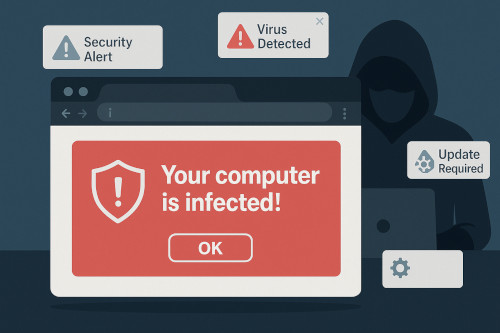
    • Using misleading language such as “Your computer is infected!” or “Critical security update required”
    • Convincing users to click Allow so the malicious website can begin sending ongoing scam notifications

    Once a user clicks Allow, the scam website can repeatedly trigger:

    • Fake virus warnings
    • Fake Windows or MacOS system alerts
    • Messages urging the user to download “security tools”
    • Prompts to call a fake “Microsoft support technician”
    • Links to malware downloads or credential-stealing phishing pages

    These alerts appear directly on the desktop, even if the user closes the browser, and often look like legitimate operating system messages. This is why employees fall for them so easily.

    The goal of these notifications is simple: push the user into panic and make them take immediate action.

    How Cybercriminals Use Fake Notifications to Compromise Systems

    Fake browser notifications have become a favorite tool of cybercriminals because they bypass many traditional defenses and rely on human psychology rather than technical exploits.

    Below are the most common attack techniques we see in the field:

    1. Tech Support Scams

    This is the most widespread form.

    A fake notification appears stating that:

    • The computer is infected
    • The user’s data is at risk
    • Microsoft or Apple has “detected unusual activity”

    The user is given a phone number to call. Once the victim calls:

    1. The scammer poses as a Microsoft technician.
    2. They request remote access to the machine.
    3. They “ diagnose” fake issues.
    4. They demand payment for repair services.

    In many cases, the attacker installs remote-access backdoors, making future intrusions trivial.

    Businesses often don’t discover the compromise until after data has been accessed or systems have been manipulated.

    2. Malware Downloads

    Fake notifications often instruct users to:

    • Update their browser
    • Install a security patch
    • Download an urgent “fix”

    These fake downloads typically contain:

    • Remote access trojans (RATs)
    • Credential stealers
    • Ransomware droppers
    • Adware or browser hijackers

    The user believes they’re installing a legitimate update, but instead they’re handing control of the system to an attacker.

    3. Credential Phishing Through “Account Locked” Alerts

    Another common method is a fake notice claiming:

    • Microsoft 365 login expired
    • Email password must be reset
    • Multi-factor authentication needs reconfiguration

    The link takes the user to a pixel-perfect imitation of an official login page. When the user enters their credentials, attackers capture their username and password, and often their MFA codes through adversary-in-the-middle techniques.

    Once inside, cybercriminals can:

    • Access email
    • Reset passwords
    • Plant forwarding rules
    • Launch Business Email Compromise (BEC) scams
    • Access cloud services such as SharePoint or OneDrive

    This type of attack is catastrophic for small businesses because it masquerades as routine account maintenance.

    4. Persistent Notification Flooding

    Even if the user doesn’t fall for the initial message, these notifications return again and again, wearing users down until they eventually click something dangerous.

    This persistence increases the likelihood of eventual compromise.

    Why Fake Browser Notifications Are So Effective

    Fake notifications succeed because they exploit both technology and human behavior.

    They look authoritative

    Notifications appear in the same location and style as real Windows or macOS alerts. This blurs the line between safe and unsafe.

    Employees trust their browser more than their inbox

    Most users have been trained to distrust suspicious emails but have not been trained to distrust fake browser warnings.

    The messaging triggers an emotional reaction

    Scam alerts use urgency and fear—two of the strongest drivers for human decision-making.

    They do not require sophisticated malware

    All the attacker needs is for the user to visit a compromised website or malicious ad. No vulnerability exploitation is required.

    They bypass antivirus

    These attacks rely on social engineering rather than malicious executables. Antivirus tools cannot prevent a user from clicking Allow on a browser pop-up.

    They target small businesses disproportionately

    Small businesses often lack:

    • Central device management
    • Controlled browser configurations
    • Zero-trust restrictions
    • Cybersecurity awareness programs

    This makes them prime targets.

    Real-World Impact on Small Businesses in California

    While many still believe cybercrime only affects large corporations, the reality is that the majority of successful attacks, especially social engineering attacks, hit small and rural businesses first.

    In recent years, numerous small California businesses have fallen victim to browser-notification–driven compromises:

    • A small agricultural office unknowingly granted remote-access to scammers, resulting in stolen banking credentials.
    • A local retail shop installed a fake antivirus “update,” which deployed ransomware across their POS systems.
    • A professional services firm suffered a Business Email Compromise after a staff member responded to a fake Microsoft 365 password reset prompt triggered from malicious notifications.

    In each case, the initial point of failure was not email, not a firewall breach, and not malware, it was a user responding to a fake browser alert.

    How NTELogic Helps Prevent and Mitigate Fake Browser Notification Threats

    At NTELogic, we take a layered approach to prevent these attacks from ever reaching your staff, and to quickly remediate incidents if they occur.

    Here’s how we protect your business:

    1. Xcitium Managed Endpoint Protection (MDR/EDR)

    Even if a user accidentally installs a fake “update,” Xcitium’s advanced MDR platform isolates unknown processes in a secure container. This ensures:

    • Malware cannot run
    • Credential stealers cannot execute
    • Ransomware cannot encrypt the system

    This single capability neutralizes the most destructive outcomes of fake browser alerts.

    2. Browser Hardening and Policy Enforcement

    For managed clients, NTELogic configures browser policies that:

    • Block unauthorized pop-up requests
    • Disable or restrict desktop notifications
    • Prevent the installation of malicious extensions
    • Force security-first browser settings across all devices

    These policies dramatically reduce exposure.

    2. Browser Hardening and Policy Enforcement

    For managed clients, NTELogic configures browser policies that:

    • Block unauthorized pop-up requests
    • Disable or restrict desktop notifications
    • Prevent the installation of malicious extensions
    • Force security-first browser settings across all devices

    These policies dramatically reduce exposure.

    4. URL Protection and Safe-Link Scanning

    For clients using our Advanced Email Protection:

    • Links are rewritten and scanned in real-time
    • Unsafe URLs are blocked before the page loads
    • Users are protected even outside the corporate network

    Because many notification scams originate from malicious ad networks, this reduces cross-channel exploitation.

    5. Cybersecurity Awareness Training

    With our Bullphish ID security awareness training platform, employees learn to identify:

    • Fake notifications
    • Browser-based malware delivery
    • Tech support scams
    • Credential phishing disguised as system alerts

    Training reduces the likelihood of human error, still the #1 cause of incidents.

    6. Local + Cloud Managed Backup

    If an incident results in system corruption, rollback is immediate. This protects your business against the rare case where malware gets installed despite safeguards.

    7. Rapid Incident Response and Remediation

    If you suspect an employee clicked a malicious notification, NTELogic:

    1. Investigates the source
    2. Terminates active threats
    3. Removes illegitimate notification permissions
    4. Reviews browser extensions
    5. Scans for remote-access tools
    6. Reviews sign-in logs and email forwarding rules
    7. Strengthens the affected workstation’s security policies

    We ensure the compromise is contained and that the user, and the organization, understands what happened and how to avoid it next time.

    How Businesses Can Reduce Their Exposure Right Now

    Even without an enterprise security platform, businesses can take these simple actions today:

    • Teach staff never to trust unsolicited alerts prompting installs, updates, or urgent action.
    • Restrict the ability for browsers to request notification permissions.
    • Keep browsers updated automatically.
    • Use a reputable ad blocker or DNS filtering solution.
    • Ensure backups are functioning and tested.

    But the most important step is partnering with a local, proactive IT provider that understands the evolving threat landscape, especially threats that evade traditional tools.

    NTELogic: Your Local Cybersecurity Partner in the Mother Lode and Central Valley

    Fake browser notifications are not harmless pop-ups, they are sophisticated social engineering tools built to steal money, credentials, and access. As these attacks continue to rise, small and rural businesses must strengthen their defenses beyond email filtering and antivirus.

    NTELogic is uniquely positioned to help local businesses because we combine:

    • 40 years of technology and emergency management experience
    • Best-in-class MDR/EDR protection
    • Advanced email and web filtering
    • Browser hardening
    • Cybersecurity awareness programs
    • Local + cloud backup
    • Rapid incident response

    We are part of this community. We’ve seen firsthand the impact of modern cyber threats on businesses across Tuolumne County, the Mother Lode, and the Central Valley. And we are committed to making sure your business stays secure, productive, and resilient.

    If you’d like an assessment of your exposure to browser-notification scams, or to explore how NTELogic can strengthen your cybersecurity posture, contact us anytime.

  • Cybersecurity in the Country – Why Businesses in Tuolumne County Can’t Afford to Ignore Cyber Crime

    Cybersecurity in the Country – Why Businesses in Tuolumne County Can’t Afford to Ignore Cyber Crime

    When most people picture cybercrime, they think of giant corporations, big-city hospitals, or government agencies getting hit by hackers.

    But in 2025, that picture is wrong.

    Across California and the nation, small and rural organizations are increasingly in the crosshairs—manufacturers, farms, clinics, local governments, food processors, retail shops, and professional offices. In many cases, these attacks are causing weeks of downtime, permanent data loss, and six-figure recovery bills.

    For businesses in places like Tuolumne County and the broader Mother Lode, cybersecurity is no longer a “big city problem.” It’s a business survival problem.

    This post looks at:

    • Why rural businesses are now prime targets
    • Common myths that keep small businesses exposed
    • Real examples of cyber incidents impacting smaller and rural California organizations
    • What “proactive cybersecurity hygiene” actually means in day-to-day operations
    • How NTELogic helps local businesses improve their security culture and resilience

    “We’re Too Small to Be a Target” – The Most Expensive Myth in Rural Business

    Attackers don’t care about your ZIP code or how many people are in your town. They care about three things:

    1. How easy you are to compromise
    2. How quickly you’ll pay to get back online
    3. How quietly they can move on to the next victim

    Recent research shows just how wrong the “only big companies get hit” myth really is:

    • Roughly 46% of all cyber breaches now impact organizations with fewer than 1,000 employees.
    • An estimated 43% of cyberattacks in 2023 targeted small businesses specifically.
    • The FBI’s 2024 Internet Crime Report logged more than 859,000 cybercrime complaints with reported losses over $16 billion, a 33% increase over the prior year.

    And small businesses are paying a heavy price. The U.S. Small Business Administration notes that cybercrimes against the small business community cost an estimated $2.9 billion in 2023 alone.

    For a local dental office, insurance agency, or construction firm, that kind of incident isn’t an inconvenience, it can threaten the business itself.

    Why Rural Businesses Are Especially Attractive Targets

    Rural communities like Tuolumne County, Calaveras County, and other parts of the Central Valley and Mother Lode share some common realities that cybercriminals quietly exploit:

    1. Limited in-house IT staff

    Most rural businesses don’t have a full-time cybersecurity team—or even a full-time IT person. Technology tends to be managed by:

    • An office manager “who’s good with computers”
    • A business owner juggling many roles
    • A remote IT provider who only gets called when something breaks

    That means critical tasks like patching, log review, MFA rollout, or staff training often get pushed aside.

    2. Older systems and specialized line-of-business apps

    Agriculture, healthcare, manufacturing, and local government often run older software and specialized systems—from feed and dairy management platforms to legacy accounting software and controllers for pumps, gates, and machinery.

    These systems are:

    • Harder to patch or update
    • Sometimes no longer supported by the vendor
    • Often exposed to the network in risky ways

    Attackers love that combination.

    3. Connectivity challenges and “workarounds”

    Rural internet constraints can lead to creative, but risky solutions:

    • Remote access tools left open to “make it easier to support sites”
    • VPNs or port forwarding set up once and never revisited
    • Shared admin passwords used on multiple systems

    These shortcuts are convenient for daily work but create a wide attack surface.

    4. Heavy dependence on uptime

    Many rural operations run 24/7 – dairies, farms, critical infrastructure, clinics, and hospitality. Shutting down even for a day can mean:

    • Spoiled product
    • Missed harvest windows
    • Lost bookings and revenue
    • Disrupted services to the community

    Attackers know that organizations under severe uptime pressure are more likely to pay ransom quickly.

    Real-World Cyber Incidents in Smaller & Rural California Communities

    You don’t have to look to Silicon Valley or Los Angeles to see the damage cybercrime can cause.

    Here are a few examples from smaller or rural California organizations:

    A California agriculture business crippled by ransomware

    A California-based agricultural business suffered a serious ransomware attack while working with a previous IT provider. The attack disrupted operations so badly that they had to rebuild their network and systems with help from a new IT security partner.

    This was not a global corporation, it was an agriculture company, the kind of business you might find in any Central Valley or foothills community.

    Grass Valley and Shafter: small cities, big cyber impacts

    The City of Grass Valley, a town of around 13,000 people, disclosed that its systems had been compromised by ransomware, with attackers threatening to publish stolen city data if ransom wasn’t paid.

    Similarly, the City of Shafter, a small agricultural city in Kern County, reported a ransomware incident that froze and locked its IT system, disrupting city services and forcing City Hall to close while the incident was investigated.

    While these are municipalities rather than private companies, the lesson is the same:

    If a small city government can be shut down by ransomware, so can a local business running similar technology and facing similar resource constraints.

    Healthcare facilities serving local communities

    Healthcare organizations that serve regional and rural populations have also been hit hard:

    • Granite Wellness Centers, which operates in Northern California communities, discovered a ransomware attack that exposed the information of approximately 15,600 patients, including health and insurance data.
    • Mission Community Hospital in Panorama City, California, has been the subject of multiple reports and legal filings following a 2023 ransomware attack in which attackers claimed to steal roughly 2.5 TB of data, including imaging records, employee information, and financial reports.

    Again, the pattern is clear: cybercriminals are not just going after national hospital chains, they’re targeting community-focused organizations that often lack enterprise-grade budgets or staffing.

    If attacks like these can hit rural or regional organizations in California, they can absolutely hit a professional office, retail shop, clinic, or ag operation in Tuolumne County.

    What Proactive Cybersecurity Hygiene Looks Like (In Plain English)

    “Cybersecurity hygiene” sounds abstract, but in practice it’s a collection of very concrete habits, tools, and decisions.

    Here’s what that looks like for a rural business that wants to stay ahead of threats.

    1. Know what you have (and where it is)
    You can’t protect what you don’t know about.

    • Maintain an inventory of devices (PCs, laptops, servers, tablets, phones, network gear).
    • Track software and line-of-business apps, including older systems that are still critical.
    • Document where your data lives (local servers, cloud apps, USB drives, backup systems, third-party services).

    2. Keep systems patched and protected
    Most attacks still succeed by exploiting known, unpatched vulnerabilities.

    • Enable automatic updates where possible.
    • Use managed endpoint protection (EDR/MDR) rather than basic consumer antivirus.
    • Regularly review and update firewall and remote access settings.

    3. Lock down identities and access
    Human logins are often the weakest link.

    • Turn on multi-factor authentication (MFA) for email, remote access, and cloud apps wherever possible.
    • Use unique, strong passwords stored in a password manager instead of reusing the same password everywhere.
    • Limit admin access, only give high-level privileges to people who truly need them.

    4. Make backup and recovery non-negotiable
    A backup you think is working is almost as dangerous as having no backup at all.

    • Use managed, monitored backups with both local and cloud copies where possible (especially important with unreliable rural internet).
    • Ensure backups are encrypted and protected from ransomware (offline or immutable copies).
    • Test restores regularly so you know how long it will take to get systems back up.

    5. Train your team – over and over
    Today’s phishing scams and phone-based social engineering (“vishing”) are sophisticated. Attackers use:

    • Look-alike domains
    • Fake Microsoft or bank logins
    • Phone calls pretending to be “IT support”

    Regular security awareness training and simulated phishing campaigns help staff recognize and report attacks instead of falling for them.

    6. Plan for the “when,” not just the “if”
    Every rural business should have a simple, clear incident response plan:

    • Who gets called first (internal and external)?
    • How do you isolate infected systems?
    • How do you communicate with customers or patients if systems are down?
    • Who handles law enforcement notifications, breach notifications, and cyber insurance claims?

    Even a 2–3 page playbook written in plain language is better than scrambling after the fact.

    Building a Security Culture in a Rural Business

    Technology is only half the story. In smaller communities, culture is often the deciding factor between resilience and disaster.

    A strong security culture in a rural business looks like:

    • Leaders talking about cybersecurity the way they talk about safety, quality, or customer service.
    • Employees feeling comfortable speaking up if something looks suspicious.
    • Regular, short “toolbox talks” or lunch-and-learns on topics like phishing, passwords, and safe remote work.
    • Clear, written policies for acceptable use, remote access, and handling sensitive data.
    • Security being considered during business decisions, not bolted on afterwards (for example, when adding a new cloud system or remote site).

    In places like Tuolumne County, where many people know each other personally, that culture can spread quickly, especially when it’s framed not as fear, but as taking care of employees, customers, and the community.

    How NTELogic Helps Rural Businesses Strengthen Cybersecurity

    NTELogic was built in and for communities like the Mother Lode and Central Valley. We understand:

    • Unreliable rural internet and the need for local + cloud strategies
    • The specialized software used by agriculture, dairy, and other rural operations
    • The realities of small IT budgets and lean staffing
    • The importance of keeping operations running 24/7

    Here’s how we support local businesses in improving their security posture and culture:

    1. Managed endpoint protection and monitoring
    We deploy and manage enterprise-grade endpoint detection and response (EDR) and remote monitoring to:

    • Detect ransomware and malware behavior early
    • Isolate compromised devices
    • Keep systems patched and up to date
    • Provide visibility across laptops, desktops, and servers

    2. Managed backup and disaster recovery
    Our NTELogic Managed Backup Service is designed with rural realities in mind:

    • Flexible selection of which data and applications to protect
    • Support for applications that store data in non-standard locations (including common ag and dairy software)
    • Encrypted backups with options for both local appliances and cloud storage
    • Regular monitoring, testing, and support when a restore is needed

    This combination helps minimize downtime and makes it much easier to say “no” to ransom demands.

    3. Secure email and identity protection
    Because so many attacks start in the inbox, we help local businesses:

    • Harden Microsoft 365 and hosted email with advanced email protection
    • Implement MFA and conditional access where supported
    • Set up and manage DKIM, SPF, and DMARC to reduce spoofing and improve email trust
    • Provide guidance on identity-based licensing and changes in Microsoft’s Office and M365 ecosystem

    4. Security awareness and culture programs
    Technology alone won’t fix human risk, so we offer:

    • Ongoing cybersecurity awareness training for employees
    • Phishing simulations tailored to common scams hitting local businesses
    • Simple, rural-friendly policies and quick-reference guides
    • Executive and owner briefings to align security with business priorities

    5. Business continuity and incident planning
    Drawing on decades of experience in business continuity, emergency management, and IT, we can help you:

    • Identify critical systems and data
    • Map out dependencies across sites and vendors
    • Build and document incident response and recovery plans
    • Run tabletop exercises so your team knows how to react under pressure

    Bringing Big-City Cybersecurity to Small-Town Businesses

    Cybercrime is no longer a distant, abstract risk reserved for Fortune 500 companies. It’s already affecting towns like Grass Valley and Shafter, regional healthcare providers, and agriculture businesses that look a lot like the operations up and down Highway 49 and 99.

    For rural businesses in Tuolumne County and the surrounding region, the choice isn’t whether to “do cybersecurity” or not. The choice is whether to approach it reactively after an incident, or proactively as part of how you run your business.

    If you’d like help:

    • Assessing where your biggest risks actually are
    • Building a realistic, affordable cybersecurity roadmap
    • Putting managed protection, backup, and training in place
    • Or simply translating all this jargon into a plan your team can follow

    NTELogic is here in your backyard, not a faceless call center three time zones away.

  • Why Sonora, CA Businesses Need Managed IT vs Reactive Break-Fix

    Why Sonora, CA Businesses Need Managed IT vs Reactive Break-Fix

    Managed IT vs Break-Fix

    In Sonora, CA, businesses of all sizes depend on technology to stay productive, competitive, and connected. But when IT issues strike—even small ones—they can bring operations to a halt. For many years, local businesses relied on the traditional “break-fix” model: something breaks, you call a tech to fix it. Simple enough on paper… but costly, unpredictable, and risky in practice.

    Today’s business environment demands a smarter approach. That’s where Managed IT Services come in. Instead of waiting for technology to fail, Managed IT keeps your systems monitored, maintained, protected, and performing—every day.

    If you own or operate a business in Sonora, here’s why Managed IT is not just an advantage, but a necessity.

    Break-Fix Is Reactive—and Reactive Is Risky

    Under the break-fix model, you only get help after something goes wrong. That means:

    • Downtime is unavoidable
    • Problems often escalate because they weren’t caught early
    • Fixes are unpredictable and often expensive
    • There’s no ongoing security monitoring
    • You’re relying on luck that nothing serious breaks

    In Sonora’s rural environment-where connectivity, aging hardware, and power fluctuations already create challenges – waiting for something to “break” before acting is an expensive gamble.

    Why Managed IT Services Are a Better Choice

    Managed IT Services take the uncertainty out of your technology. Instead of reacting to problems, a Managed Service Provider (MSP) like NTELogic monitors your systems around the clock, identifies issues before they become outages, and keeps everything secure and up-to-date.

    With Managed IT, Sonora businesses get:

    Predictable, Budget-Friendly Costs

    • Monthly flat-rate pricing means no surprise bills or “emergency” charges. You budget once and get ongoing care.

    Always-Up-to-Date Systems

    • Regular patching, updates, and maintenance prevent vulnerabilities and improve performance.

    Stronger Cybersecurity

    • From advanced endpoint protection to staff security training, Managed IT adds layers of defense that break-fix simply doesn’t provide.

    Continuous Monitoring

    • Systems are monitored 24/7, catching issues instantly—often before you even know something was wrong.

    Reduced Downtime

    • Faster response times, proactive maintenance, and early detection all mean one thing: your business stays running.

    In Sonora, CA, businesses of all sizes depend on technology to stay productive, competitive, and connected. But when IT issues strike—even small ones—they can bring operations to a halt. For many years, local businesses relied on the traditional “break-fix” model: something breaks, you call a tech to fix it. Simple enough on paper… but costly, unpredictable, and risky in practice.

    Today’s business environment demands a smarter approach. That’s where Managed IT Services come in. Instead of waiting for technology to fail, Managed IT keeps your systems monitored, maintained, protected, and performing—every day.

    If you own or operate a business in Sonora, here’s why Managed IT is not just an advantage, but a necessity.

    Break-Fix Is Reactive—and Reactive Is Risky

    Under the break-fix model, you only get help after something goes wrong. That means:

    • Downtime is unavoidable
    • Problems often escalate because they weren’t caught early
    • Fixes are unpredictable and often expensive
    • There’s no ongoing security monitoring
    • You’re relying on luck that nothing serious breaks

    In Sonora’s rural environment-where connectivity, aging hardware, and power fluctuations already create challenges – waiting for something to “break” before acting is an expensive gamble.

    Why Managed IT Services Are a Better Choice

    Managed IT Services take the uncertainty out of your technology. Instead of reacting to problems, a Managed Service Provider (MSP) like NTELogic monitors your systems around the clock, identifies issues before they become outages, and keeps everything secure and up-to-date.

    With Managed IT, Sonora businesses get:

    Predictable, Budget-Friendly Costs

    • Monthly flat-rate pricing means no surprise bills or “emergency” charges. You budget once and get ongoing care.

    Always-Up-to-Date Systems

    • Regular patching, updates, and maintenance prevent vulnerabilities and improve performance.

    Stronger Cybersecurity

    • From advanced endpoint protection to staff security training, Managed IT adds layers of defense that break-fix simply doesn’t provide.

    Continuous Monitoring

    • Systems are monitored 24/7, catching issues instantly—often before you even know something was wrong.

    Reduced Downtime

    Faster response times, proactive maintenance, and early detection all mean one thing: your business stays running.

    Unique IT Challenges for Sonora, CA Businesses

    Operating in the Sierra foothills presents conditions that make Managed IT especially important:

    • Spotty or inconsistent broadband
    • Older infrastructure common in historic and rural buildings
    • Limited in-house IT staff
    • Greater exposure to wildfire-related power events
    • Local businesses often running 24/7 operations (hospitality, agriculture, retail, health services)

    Downtime in Sonora isn’t just inconvenient—it’s expensive. Whether you’re running a shop in downtown Sonora, managing a ranch, or coordinating a professional office, you need technology that’s dependable and supported.

    The Hidden Costs of Break-Fix

    Many Sonora businesses initially choose break-fix because it seems cheaper. But hidden costs add up fast:

    • Emergency repair fees
    • Lost productivity
    • Lost sales
    • Damaged customer trust
    • Data loss or breach risk
    • Repeated issues because root causes aren’t addressed

    Managed IT eliminates these unpredictable “surprise” costs and replaces them with stability and strategic care.

    How Managed IT Drives Growth

    Technology shouldn’t slow you down. With Managed IT, local businesses benefit from:

    • Strategic IT planning
    • Cloud solutions to improve mobility
    • Centralized communications
    • Secure remote access
    • Scalable support as your business grows

    Instead of calling for help when something is broken, you have a partner invested in keeping you operational and moving forward.

    Why Sonora Businesses Choose NTELogic

    NTELogic is proudly based in Sonora and serves the entire Mother Lode. We understand the unique needs of local businesses and provide services built specifically for rural and foothill operations.

    Our Managed IT program includes:

    • 24/7 monitoring
    • Advanced cybersecurity
    • Managed backups
    • Patch and update management
    • Help desk support
    • Business continuity planning
    • Proactive system maintenance
    • Network and endpoint protection

    With NTELogic, you’re not just getting an IT service, you’re getting peace of mind.

    Final Thoughts

    The days of “call when something breaks” are over. For Sonora businesses that want to stay secure, efficient, and competitive, Managed IT is the smart, predictable, and cost-effective solution.

    If you’re ready to stop fighting fires and start focusing on your business, NTELogic is here to help.

    Stay Secure. Stay Productive. Stay Ahead.

    Your business deserves technology that works – without surprises, downtime, or security gaps.

    NTELogic’s Managed IT Services protect your systems, your data, and your productivity with proactive monitoring, expert support, and next-generation security designed for Sonora and the Mother Lode.

    • 24/7 monitoring and support
    • Advanced cybersecurity protection
    • Reliable managed backups
    • Predictable, fixed monthly cost
     

    Ready to upgrade from break-fix to true peace of mind? Call us at (209) 694-4599

  • Cyber Insurance Basics: What Every Business Needs to Know

    Cyber Insurance Basics: What Every Business Needs to Know

    Cyberattacks rarely come with a warning, and when they hit, the damage can be fast and costly. From data recovery to managing the fallout, a single breach can derail your operations for days or weeks.

    That’s where cyber insurance can step in to reduce the financial impact of an attack.

    However, not all policies offer the same protection. What is and isn’t covered often depends on whether your business met the insurer’s security expectations before the incident.

    In the sections ahead, we’ll break down what that means and how to prepare.

    What is cyber insurance and why does it matter?

    Cyber insurance is a policy designed to help businesses recover from digital threats like data breaches and ransomware attacks. It can cover the cost of cleanup when systems are compromised and reputations are on the line.

    Depending on the policy, cyber insurance may cover:

    • Data recovery and system restoration
    • Legal fees and regulatory fines
    • Customer notification and credit monitoring
    • Business interruption losses
    • Ransom payments (in some cases)

    While cyber insurance is a smart investment, getting insured is only the first step. What you do afterward, like maintaining strong cyber hygiene, can determine whether your claim holds up.

    Why cyber insurance claims are often denied

    • A cyber insurance policy doesn’t guarantee a payout. Insurers carefully assess cybersecurity measures before paying out. Common reasons for denied claims include:
      Lack of proper security controls
    • Outdated software or unpatched systems
    • Incomplete or insufficient documentation
    • Improper incident response plan

    A policy only goes so far; you need to prove that your digital house was in order before the incident occurred.

    How to strengthen your cyber insurance readiness

    To avoid costly claim denials, your security posture needs to match the expectations of your insurer. That means implementing the very safeguards many underwriters now require:

    • Strong cybersecurity fundamentals like multi-factor authentication (MFA), backup systems and endpoint protection
    • A documented incident response plan
    • Routine updates and patching
    • Continuous employee training focused on cyber hygiene
    • Regular risk assessments and remediation

    This is where working with the right IT partner can make all the difference.

    The role of your IT partner in cyber insurance

    An experienced IT service provider like us can help you close the security gaps that insurers look for, ensuring your infrastructure meets their standards and your business is ready to respond when it matters most.

    Let’s talk about how we can turn your IT strategy into a true asset that protects your business and strengthens your insurance position.


    SCHEDULE CONSULTATION

  • What Small Business Owners Need to Know About Email Spoofing

    What Small Business Owners Need to Know About Email Spoofing

    In today’s digital world, email remains the top method cybercriminals use to target businesses—and one of their most effective tactics is email spoofing. Email spoofing occurs when a bad actor forges the sender address on an email to make it look like it’s coming from a trusted source. This could be a vendor, a customer, or even someone inside your own organization. The goal? Trick you or your employees into taking an action, like clicking a malicious link or transferring funds to a fraudulent account.

    Email spoofing is often the first step in a phishing attack, which is a broader scam that uses social engineering to deceive recipients into revealing sensitive information, downloading malware, or authorizing fraudulent transactions. According to the FBI’s Internet Crime Complaint Center (IC3), phishing was the most common type of cybercrime in 2023, with over 298,000 complaints filed and losses exceeding $2.9 billion. Spoofed emails are convincing because they can bypass basic spam filters and appear to come from a legitimate domain—unless more advanced protections are in place.

    Recognizing a spoofed email can be tricky, but there are telltale signs to look for. Watch for inconsistencies in the sender’s email address—hover over the name to see the actual address it came from. Be suspicious of urgent requests, especially those involving financial transactions or password changes. Poor grammar, unusual phrasing, or unexpected attachments are also red flags. If the email claims to be from someone you know but seems out of character, trust your instincts and verify the message through another communication channel. Always encourage your employees to “think before they click.”

    Unfortunately, many small businesses underestimate how vulnerable they are. Cybercriminals often assume that small organizations lack robust cybersecurity defenses, and they’re not wrong. A 2025 study by Verizon found that small businesses are being targeted 4 times more than large organizations Without the right tools, it’s nearly impossible to detect spoofed emails before the damage is done. That’s why it’s critical to implement an email security posture—a layered approach to defending against phishing, spoofing, and other email-borne threats.

    This is where partnering with a Technology Solutions Provider (TSP) like NTELogic makes all the difference. NTELogic helps small businesses identify vulnerabilities and implement best practices such as SPF, DKIM, and DMARC—email authentication protocols designed to prevent spoofing. We also provide advanced threat detection, user training, and real-time monitoring to safeguard your business.

    Cybersecurity isn’t a one-time setup—it’s an ongoing process. By working with experts like NTELogic, you can stay ahead of evolving threats and ensure that your email systems are not the weakest link. Don’t wait until a spoofed email becomes a costly lesson. Contact us today to learn how we can strengthen your cybersecurity posture and protect what matters most—your business.


  • Key Steps for Successful Business Continuity Planning

    Imagine being the owner of the most popular coffee joint on the corner. Your loyal customers line up outside each morning, eager to grab their caffeine fix. But, one day, as your staff hustles to keep up with the orders, a sudden storm knocks out the power, leaving the cafe in the dark. Or worse, a cyberattack targets your billing system, leaving a long line of frustrated customers.

    Unexpected chaos can strike any business at any time. One moment, you’re basking in the glory of running a successful establishment; the next, you’re thrown against a wall, staring at a crisis that could disrupt your entire business. Don’t let this be your story.

    In this blog, we’ll show you the key steps to create a Business Continuity Plan (BCP) that works for you and ensures your business stays up and running, even in the face of disaster.

    Key steps to successful business continuity planning

    Here is how you can stay resilient in the face of any challenge:

    Find what’s important for your business and prioritize it.
    Identify what’s necessary for your business. It’s crucial how you prioritize your business-critical resources. Once you’ve figured that out, try to understand how sudden disruptions can affect these functions.

    For example, if you run a coffee shop, brewing coffee and serving customers would be some of the essential functions of your business. You’d need to understand how disruptions can impact your business. Similarly, you must also ensure your kitchen runs efficiently while your coffee supply remains steady.

    Develop a comprehensive plan.
    Provide your team with clear, step-by-step instructions on the actions to take during a disruption. One goal is to minimize downtime, so assigning team members tasks to help manage disruptions efficiently is critical.

    For example, say you own a bakery, and your oven fails. You should have a plan that helps your team manage orders and communicate the delay to your customers. You should allocate specific roles to members to handle the repair work or the communication.

    Leverage the latest tools to protect business data.
    Some tools and solutions can take data backups automatically. The data is then saved in the cloud and can be retrieved when you need it. Similarly, you can utilize failover systems to switch to backup systems in a disaster.

    For example, if you run a gym, you can regularly back up and save your membership records on the cloud. The copies of all critical information can be accessed anytime and retrieved in case of a disruption. Additionally, you could keep an extra Point of Sale (POS) device in case your other payment options fail.

    Train your staff and test for preparedness.
    Regularly train your staff to improve team preparedness by simulating mock scenarios. This will help you test both your business continuity plan and your team’s efficiency. You can update and enhance your BCP per your business needs based on the training and testing.

    For example, restaurant staff should have ample instruction on how to handle kitchen fires. Similarly, the waitstaff must be prepared to handle backup billing machines and manage customer orders.

    Involve key stakeholders.
    Consider the opinions and feedback from your managers and key staff members. For the success of your BCP, it’s crucial to keep everyone in the loop as you update and make changes.

    For example, your cafe staff can share valuable information that could be important while building your BCP. It’s vital to keep them updated on changes to ensure everyone is on the same page.

    Continuous monitoring and improvement.
    Technical problems can come up at any time. Make it a standard practice to regularly look for potential system issues early. After a disruption, consider gathering information from your staff and customers to improve your continuity plan.

    For example, coffee and customer billing machines are the business-critical systems for a cafe. It’s crucial for you to check these types of equipment regularly for any issues. Use any disruption as an opportunity to improve. Take feedback from customers and your employees.

    Simplify continuity planning

    It can be overwhelming to implement business continuity planning, especially while managing your business independently. That’s where an experienced IT service provider can step in. From helping you identify critical business functions to implementing failover systems and conducting regular tests, we can guide you through every step of the way.

    Our experts will ensure that your BCP is effective and tailored to your unique business needs. Contact us today and let’s make continuity planning stress-free for you.