
Tag: cybersecurity threats

  • The Hidden Cyber Threat in Your Browser: How Fake Notifications Put Businesses at Risk – and How NTELogic Helps Protect You

    The Hidden Cyber Threat in Your Browser: How Fake Notifications Put Businesses at Risk – and How NTELogic Helps Protect You

    For years, businesses have invested in firewalls, antivirus platforms, cybersecurity awareness training, and email protection to keep cybercriminals at bay. Yet one of today’s most successful attack vectors doesn’t arrive as a suspicious email or an infected attachment. It arrives through the very thing employees use every day: the web browser.

    Fake browser notifications, also called browser push-notification scams, malicious pop-ups, and fake system alerts, are rapidly becoming one of the most common ways cybercriminals trick users into installing malware, sharing credentials, or calling scam phone numbers. These attacks bypass traditional security layers and prey on a user’s trust in the browser or the operating system.

    This growing risk is especially relevant for rural businesses throughout the Mother Lode and Central Valley, where lean IT staff and high daily workloads mean employees often “click first, think later.” In this environment, criminals know they only need one person to fall for a fake alert to create a costly incident.

    At NTELogic, we see these threats on a weekly, and sometimes daily, basis. This post explains how fake browser notifications work, why they’ve become so successful, real-world impacts on small and mid-sized businesses, and how NTELogic’s layered security approach keeps your organization protected.

    Understanding the Threat: What Are Fake Browser Notifications?

    Modern browsers like Chrome, Edge, and Firefox allow websites to display push notifications, similar to mobile app alerts, after the user clicks Allow when prompted. This is a legitimate feature designed to let trusted sites send updates.

    Cybercriminals exploit this feature by:

    • Forcing pop-ups that imitate real browser messages
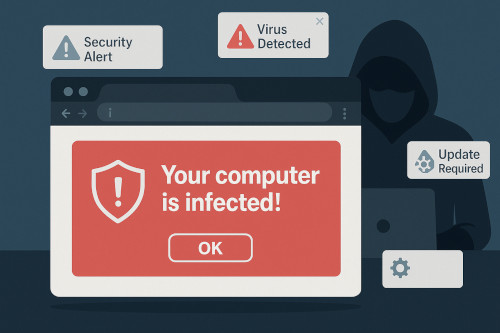
    • Using misleading language such as “Your computer is infected!” or “Critical security update required”
    • Convincing users to click Allow so the malicious website can begin sending ongoing scam notifications

    Once a user clicks Allow, the scam website can repeatedly trigger:

    • Fake virus warnings
    • Fake Windows or MacOS system alerts
    • Messages urging the user to download “security tools”
    • Prompts to call a fake “Microsoft support technician”
    • Links to malware downloads or credential-stealing phishing pages

    These alerts appear directly on the desktop, even if the user closes the browser, and often look like legitimate operating system messages. This is why employees fall for them so easily.

    The goal of these notifications is simple: push the user into panic and make them take immediate action.

    How Cybercriminals Use Fake Notifications to Compromise Systems

    Fake browser notifications have become a favorite tool of cybercriminals because they bypass many traditional defenses and rely on human psychology rather than technical exploits.

    Below are the most common attack techniques we see in the field:

    1. Tech Support Scams

    This is the most widespread form.

    A fake notification appears stating that:

    • The computer is infected
    • The user’s data is at risk
    • Microsoft or Apple has “detected unusual activity”

    The user is given a phone number to call. Once the victim calls:

    1. The scammer poses as a Microsoft technician.
    2. They request remote access to the machine.
    3. They “ diagnose” fake issues.
    4. They demand payment for repair services.

    In many cases, the attacker installs remote-access backdoors, making future intrusions trivial.

    Businesses often don’t discover the compromise until after data has been accessed or systems have been manipulated.

    2. Malware Downloads

    Fake notifications often instruct users to:

    • Update their browser
    • Install a security patch
    • Download an urgent “fix”

    These fake downloads typically contain:

    • Remote access trojans (RATs)
    • Credential stealers
    • Ransomware droppers
    • Adware or browser hijackers

    The user believes they’re installing a legitimate update, but instead they’re handing control of the system to an attacker.

    3. Credential Phishing Through “Account Locked” Alerts

    Another common method is a fake notice claiming:

    • Microsoft 365 login expired
    • Email password must be reset
    • Multi-factor authentication needs reconfiguration

    The link takes the user to a pixel-perfect imitation of an official login page. When the user enters their credentials, attackers capture their username and password, and often their MFA codes through adversary-in-the-middle techniques.

    Once inside, cybercriminals can:

    • Access email
    • Reset passwords
    • Plant forwarding rules
    • Launch Business Email Compromise (BEC) scams
    • Access cloud services such as SharePoint or OneDrive

    This type of attack is catastrophic for small businesses because it masquerades as routine account maintenance.

    4. Persistent Notification Flooding

    Even if the user doesn’t fall for the initial message, these notifications return again and again, wearing users down until they eventually click something dangerous.

    This persistence increases the likelihood of eventual compromise.

    Why Fake Browser Notifications Are So Effective

    Fake notifications succeed because they exploit both technology and human behavior.

    They look authoritative

    Notifications appear in the same location and style as real Windows or macOS alerts. This blurs the line between safe and unsafe.

    Employees trust their browser more than their inbox

    Most users have been trained to distrust suspicious emails but have not been trained to distrust fake browser warnings.

    The messaging triggers an emotional reaction

    Scam alerts use urgency and fear—two of the strongest drivers for human decision-making.

    They do not require sophisticated malware

    All the attacker needs is for the user to visit a compromised website or malicious ad. No vulnerability exploitation is required.

    They bypass antivirus

    These attacks rely on social engineering rather than malicious executables. Antivirus tools cannot prevent a user from clicking Allow on a browser pop-up.

    They target small businesses disproportionately

    Small businesses often lack:

    • Central device management
    • Controlled browser configurations
    • Zero-trust restrictions
    • Cybersecurity awareness programs

    This makes them prime targets.

    Real-World Impact on Small Businesses in California

    While many still believe cybercrime only affects large corporations, the reality is that the majority of successful attacks, especially social engineering attacks, hit small and rural businesses first.

    In recent years, numerous small California businesses have fallen victim to browser-notification–driven compromises:

    • A small agricultural office unknowingly granted remote-access to scammers, resulting in stolen banking credentials.
    • A local retail shop installed a fake antivirus “update,” which deployed ransomware across their POS systems.
    • A professional services firm suffered a Business Email Compromise after a staff member responded to a fake Microsoft 365 password reset prompt triggered from malicious notifications.

    In each case, the initial point of failure was not email, not a firewall breach, and not malware, it was a user responding to a fake browser alert.

    How NTELogic Helps Prevent and Mitigate Fake Browser Notification Threats

    At NTELogic, we take a layered approach to prevent these attacks from ever reaching your staff, and to quickly remediate incidents if they occur.

    Here’s how we protect your business:

    1. Xcitium Managed Endpoint Protection (MDR/EDR)

    Even if a user accidentally installs a fake “update,” Xcitium’s advanced MDR platform isolates unknown processes in a secure container. This ensures:

    • Malware cannot run
    • Credential stealers cannot execute
    • Ransomware cannot encrypt the system

    This single capability neutralizes the most destructive outcomes of fake browser alerts.

    2. Browser Hardening and Policy Enforcement

    For managed clients, NTELogic configures browser policies that:

    • Block unauthorized pop-up requests
    • Disable or restrict desktop notifications
    • Prevent the installation of malicious extensions
    • Force security-first browser settings across all devices

    These policies dramatically reduce exposure.

    2. Browser Hardening and Policy Enforcement

    For managed clients, NTELogic configures browser policies that:

    • Block unauthorized pop-up requests
    • Disable or restrict desktop notifications
    • Prevent the installation of malicious extensions
    • Force security-first browser settings across all devices

    These policies dramatically reduce exposure.

    4. URL Protection and Safe-Link Scanning

    For clients using our Advanced Email Protection:

    • Links are rewritten and scanned in real-time
    • Unsafe URLs are blocked before the page loads
    • Users are protected even outside the corporate network

    Because many notification scams originate from malicious ad networks, this reduces cross-channel exploitation.

    5. Cybersecurity Awareness Training

    With our Bullphish ID security awareness training platform, employees learn to identify:

    • Fake notifications
    • Browser-based malware delivery
    • Tech support scams
    • Credential phishing disguised as system alerts

    Training reduces the likelihood of human error, still the #1 cause of incidents.

    6. Local + Cloud Managed Backup

    If an incident results in system corruption, rollback is immediate. This protects your business against the rare case where malware gets installed despite safeguards.

    7. Rapid Incident Response and Remediation

    If you suspect an employee clicked a malicious notification, NTELogic:

    1. Investigates the source
    2. Terminates active threats
    3. Removes illegitimate notification permissions
    4. Reviews browser extensions
    5. Scans for remote-access tools
    6. Reviews sign-in logs and email forwarding rules
    7. Strengthens the affected workstation’s security policies

    We ensure the compromise is contained and that the user, and the organization, understands what happened and how to avoid it next time.

    How Businesses Can Reduce Their Exposure Right Now

    Even without an enterprise security platform, businesses can take these simple actions today:

    • Teach staff never to trust unsolicited alerts prompting installs, updates, or urgent action.
    • Restrict the ability for browsers to request notification permissions.
    • Keep browsers updated automatically.
    • Use a reputable ad blocker or DNS filtering solution.
    • Ensure backups are functioning and tested.

    But the most important step is partnering with a local, proactive IT provider that understands the evolving threat landscape, especially threats that evade traditional tools.

    NTELogic: Your Local Cybersecurity Partner in the Mother Lode and Central Valley

    Fake browser notifications are not harmless pop-ups, they are sophisticated social engineering tools built to steal money, credentials, and access. As these attacks continue to rise, small and rural businesses must strengthen their defenses beyond email filtering and antivirus.

    NTELogic is uniquely positioned to help local businesses because we combine:

    • 40 years of technology and emergency management experience
    • Best-in-class MDR/EDR protection
    • Advanced email and web filtering
    • Browser hardening
    • Cybersecurity awareness programs
    • Local + cloud backup
    • Rapid incident response

    We are part of this community. We’ve seen firsthand the impact of modern cyber threats on businesses across Tuolumne County, the Mother Lode, and the Central Valley. And we are committed to making sure your business stays secure, productive, and resilient.

    If you’d like an assessment of your exposure to browser-notification scams, or to explore how NTELogic can strengthen your cybersecurity posture, contact us anytime.

  • Why Dark Web Monitoring Is More Important Than Ever After the OnSolve CodeRed Data Breach

    Why Dark Web Monitoring Is More Important Than Ever After the OnSolve CodeRed Data Breach

    When news broke of the recent OnSolve CodeRed data breach, many businesses – especially those in rural communities like Tuolumne County – wondered what it meant for them. After all, OnSolve is a major provider of critical event management and emergency notification systems. A breach involving an organization of that size sends a clear message: no business, no matter how large or small, is immune to today’s cyberthreats.

    But beyond the headlines lies a deeper, more urgent issue: cybercriminals are no longer simply breaking into networks – they are rapidly selling what they find on the dark web. And once your data appears there, the risk of fraud, credential compromise, ransomware, or targeted attacks increases dramatically.

    This is why Dark Web Monitoring is now an essential component of every organization’s cybersecurity strategy.

    In this post, we’ll break down what happened with the CodeRed breach, why the dark web poses such a serious threat to businesses (especially in rural regions like the Mother Lode and Central Valley), and how proactive monitoring can help you stay ahead of danger instead of reacting after it’s too late.

    Understanding the OnSolve CodeRed Data Breach

    OnSolve’s CodeRed system is widely used by government agencies, emergency response teams, and municipalities to deliver alerts and notifications. While the full scope of the breach is still being evaluated, the incident underscores the reality that even large, well-funded organizations with robust cybersecurity programs can fall victim to sophisticated attacks.

    A breach involving a mass-notification system raises several risks:

    • Exposure of contact information including email addresses and phone numbers
    • Compromised credentials, allowing attackers to impersonate users
    • Supply-chain style risks, where attackers pivot from a major provider into smaller, dependent organizations
    • Phishing campaigns targeting users who expect legitimate notifications

    Once this information finds its way into criminal marketplaces, the impact is amplified, sometimes exponentially.

    This is where dark web activity becomes a major factor.

    What the Dark Web Really Is, and Why It Matters

    The dark web is not a place most people interact with directly. It’s a hidden portion of the internet where anonymity is the rule, not the exception. For cybercriminals, it serves as:

    • A marketplace for stolen data
    • A meeting place to coordinate attacks
    • A distribution channel for malware, credentials, exploits, and ransomware
    • A tool to identify which businesses are prime targets based on available data

    For example:
    If attackers obtain a list of emails from an emergency alert system, they can:

    • Sell those email addresses to phishing groups
    • Launch “credential stuffing” attacks
    • Use the data to craft highly targeted messages
    • Attempt to impersonate government or first responder organizations
    • Create SMS or phone-based scams

    Businesses that assume their size or location protects them are at the highest risk, because attackers know that smaller and rural companies tend to have weaker defenses.

    Why Rural Businesses Are Especially Vulnerable

    In areas like Tuolumne County, Calaveras County, and the broader Mother Lode region, many businesses fall into the category of small to mid-size. They typically:

    • Have fewer cybersecurity resources
    • Rely on a lean staff
    • Use older systems or out-of-date technology
    • Depend on vendors for IT support
    • Have limited time to focus on security hygiene

    Attackers know this.

    When data breaches occur – especially at large providers – the ripple effect often hits smaller businesses hardest. Real examples from rural California in the last decade show how devastating these attacks can be:

    • A small agricultural business in the Central Valley suffered a six-figure loss from a Business Email Compromise tied to stolen credentials.
    • A rural medical provider in Northern California experienced a ransomware incident linked to a leaked email/password pair.
    • Multiple small businesses in the foothills had their accounts compromised due to employee passwords appearing in dark web dumps.

    The takeaway is simple:
    Hackers aren’t targeting businesses. They’re targeting data.
    And rural businesses have valuable data just like everyone else.

    Dark Web Monitoring: Your Early Warning System

    Dark Web Monitoring is essentially a sentinel, one that works 24/7, continuously scanning criminal marketplaces, breach repositories, and hidden forums looking for:

    • Compromised emails
    • Leaked passwords
    • Stolen credentials
    • Exposed financial records
    • Company-specific data
    • Information tied to employees, vendors, or partners

    Our Dark Web Monitoring service is automated and constant. The moment your data appears in a new breach, we receive an alert and can take action.

    This matters because:

    1. Stolen Data Can Be Used Within Minutes

    Attackers rarely wait. They automate everything.

    If your email and password appear in a breach today, hackers may begin attempting logins within hours.

    Dark Web Monitoring gives you the jump you need to reset passwords, stop unauthorized access, and block suspicious activity.

    2. Hackers Sell Access Before You Know There’s a Problem

    Many companies have no idea their credentials have leaked.

    Dark Web Monitoring sees what you can’t, and what your staff won’t recognize until it’s too late.

    3. Phishing Attacks Become More Convincing

    With stolen data, criminals craft messages that look authentic.

    A phishing message targeting someone who uses CodeRed alerts, for example, may appear to come from emergency management services.

    Monitoring helps you identify and prepare for these targeted attacks.

    4. Credential Reuse Makes Attacks Far More Dangerous

    Employees often reuse passwords across:

    • Work email
    • Personal email
    • Social media
    • Banking or financial services
    • Client systems
    • Vendor portals

    A breach in one area puts all others at risk. Dark Web Monitoring helps identify those weak points.

    5. Compliance Requirements Are Tightening

    Many industries now require:

    • Continuous monitoring
    • Credential exposure alerts
    • Proof of breach detection
    • Incident response workflow

    Dark Web Monitoring forms the foundation of these requirements.

    What the OnSolve Breach Teaches Us

    The CodeRed incident reinforces a reality we’ve seen over and over:

    Security is no longer only about prevention. It’s also about detection and response.

    Even large organizations with full IT teams and advanced cybersecurity tools can face breaches. This means smaller businesses must shift their mindset from “We’re too small to be targeted” to “We must know the moment our data becomes exposed.”

    The longer compromised data remains undetected, the greater the risk.

    Dark Web Monitoring shortens that window dramatically.

    Real-World Scenarios: How Dark Web Monitoring Protects Your Business

    Scenario 1: A Compromised Work Email

    An employee’s email is found in a new breach. NTELogic receives an alert and immediately:

    1. Forces a password reset
    2. Reviews sign-in logs
    3. Verifies MFA is enabled
    4. Checks for forwarding rules (commonly used by attackers)
    5. Alerts leadership if suspicious activities appear

    This stops a Business Email Compromise before it starts.

    Scenario 2: Customer or Vendor Data Appears on the Dark Web

    Exposed vendor accounts can jeopardize your business too.

    For example, a vendor’s breached credentials could grant access to your billing portal, cloud storage, or shared systems.

    With monitoring, you can enforce resets proactively and avoid a downstream compromise.

    Scenario 3: An Employee Uses the Same Password on Facebook and Their Work Email

    This one is extremely common – and extremely dangerous.

    If the Facebook password leaks, attackers immediately try it on:

    • Outlook
    • Microsoft 365
    • Remote access portals
    • VPNs
    • Payroll systems

    Dark Web Monitoring identifies the exposure immediately.

    Scenario 4: Passwords for a Shared Mailbox Appear Online

    Shared accounts are especially dangerous because:

    • Many employees know the password
    • MFA is often disabled
    • Attackers can log in silently

    Monitoring alerts you to rotate the credentials and enable protections.

    How NTELogic Helps Businesses Stay Protected

    Our Dark Web Monitoring service is designed for local businesses that need real protection without enterprise-level complexity.

    We provide:

    Continuous monitoring

    24/7 scanning of dark web markets, criminal databases, and breach repositories.

    Alerts when your data appears in a breach

    You’re notified immediately when there is an issue.

    Guided response & remediation

    We don’t just alert you, we help you fix it.

    Integrated security

    Combined with our MDR/EDR platform, AEP, and Managed Backup services, this forms a full security stack.

    Protection tailored to rural businesses

    We understand the realities of bandwidth, staffing, and budget in the Mother Lode.

    Ongoing cybersecurity training

    To reduce risk from phishing, weak passwords, and targeted attacks.

    What You Should Do Next

    In light of the CodeRed breach and the increasing sophistication of cybercriminals, every business – large or small – should take a proactive step forward.

    Here’s what we recommend:

    1. Enable Dark Web Monitoring immediately

    If you’re not already enrolled, we can activate it in minutes.

    2. Enforce MFA everywhere

    If you’re unsure whether your team is set up, we can review it.

    3. Strengthen your password policy

    Long, unique passphrases are best.

    4. Review your backup and disaster recovery strategy

    Especially important for rural areas where internet outages can complicate recovery.

    5. Educate your users

    A trained team is your strongest defense.

    Final Thoughts

    The OnSolve CodeRed breach is a reminder that cybersecurity is not an IT issue, it’s a business continuity issue.

    Threat actors don’t discriminate based on location, business size, or industry. They harvest data at scale and sell it to whoever will pay for it.

    The best defense is staying ahead of them.

    Dark Web Monitoring gives you the visibility you need to protect your business, your staff, your customers, and your reputation.

    If you’d like to enable Dark Web Monitoring or integrate it into your full security stack, NTELogic is ready to help.