
Tag: cybersecurity

  • Cybersecurity Starts With Your Team: Uncovering Threats and the Benefits of Training

    Cybersecurity Starts With Your Team: Uncovering Threats and the Benefits of Training

    When you think about cybersecurity, your mind might jump to firewalls, antivirus software or the latest security tools. But let’s take a step back—what about your team? The reality is that even with the best technology, your business is only as secure as the people who use it every day.

    Here’s the thing: cybercriminals are intelligent. They know that targeting employees is often the easiest way into your business. And the consequences? They can range from data breaches to financial losses and a lot of sleepless nights.

    So, let’s break this down. What threats should you be worried about, and how can regular training protect your team and business?

    Common cyberthreats that specifically target employees

    These are some of the main ways attackers try to trick your team:

    • Social engineering
      This is a tactic in almost all cybercriminal playbooks. Attackers rely on manipulation, posing as trusted individuals or creating urgency to fool employees into sharing confidential data or granting access. It’s about exploiting trust and human behavior rather than technology.
    • Phishing
      A popular form of social engineering, phishing involves deceptive emails or messages that look official but aim to steal sensitive information or prompt clicks on harmful links.
    • Malware
      Malware refers to malicious software designed to infiltrate systems and steal data, corrupt files or disrupt operations. It often enters through unintentional downloads or unsafe websites, putting your data and functionality at risk.
    • Ransomware
      A specific kind of malware, ransomware, encrypts files and demands payment to unlock them. It’s one of the most financially damaging attacks, holding businesses hostage until a hefty ransom is paid.
    Employee cyber awareness training and its benefits

    You wouldn’t let someone drive your car without knowing the rules of the road, right? The same logic applies here. Cyber awareness training equips your team with the knowledge to spot and stop threats before they escalate. It’s about turning your employees from potential targets into your first line of defense.

    The benefits of regular employee cyber awareness training are:

    • Fewer data breaches
      Well-trained employees are less likely to fall for phishing or other scams, which lowers the chance of a data breach.
    • Stronger compliance
      Many industries require security training to meet legal standards. By staying compliant, you avoid potential fines and build trust with partners.
    • Better reputation
      Showing a commitment to security through regular training shows clients and customers that you take data protection seriously.
    • Faster responses
      When employees know how to spot and report issues quickly, the response to any threat is faster and more effective, minimizing potential damage.
    • Reduced insider threats
      Educated employees understand the risks, minimizing both accidental and intentional insider threats.
    • Cost savings
      Data breaches come with huge costs, from legal fees to loss of customer trust. Training can lessen the chances of cyber incidents and save your company money in the long run.
    So, where do you start?

    Start with a solid cybersecurity program. This isn’t a one-and-done deal. It’s ongoing. Your team needs to stay updated on new threats and best practices. And it’s not just about sitting through a boring presentation. Make it engaging, practical and relevant to their daily roles.

    By investing in your team, you’re not just boosting their confidence—you’re safeguarding your business. And in a world where cyberthreats evolve faster than ever, that’s a win you can count on.

    Not sure how to do it alone? Send us a message. Our years of experience and expertise in cyber awareness training are exactly what you need.
  • Common Risk Assessment Myths That Every Business Owner Needs to Know

    Despite believing they were immune, a small law firm in Maryland fell victim to a ransomware attack. Similarly, an accounting firm in the Midwest lost all access to its client information, financial records and tax files. They assumed that antivirus software was all the security they needed to thwart a cyberattack.

    In both incidents, the victims were small businesses that fell prey to sophisticated cyberattacks because of hidden security vulnerabilities that a comprehensive risk assessment could’ve identified.

    When it comes to IT risk assessments, business owners have several misconceptions that leave them vulnerable. In this blog, we’ll uncover common cyber risk assessment myths and discuss the reality. By the end, we’ll also show you how to build an effective risk assessment strategy.

    Misconceptions can hurt your business.

    Here are some common myths that all business owners must avoid:

    Myth 1: We’re too small to be a target.

    Reality: Hackers often use automated tools to look for vulnerabilities in a system, and small businesses invariably end up on the receiving end since many of them lack the resources to build a strong cybersecurity posture.

    Myth 2: Risk assessments are too expensive.

    Reality: When you factor in the actual business loss due to a cyberattack, investing in proactive cybersecurity makes for a smart business decision. Proactive security practices not only protect your money but also save you from costly lawsuits and reputational damage.

    Myth 3: We have antivirus software, so we’re protected.

    Reality: You can’t rely only on antivirus software to protect your IT infrastructure. Cybercriminals today have become highly skilled and can effortlessly deploy advanced threats. To secure your business, you must have a comprehensive risk assessment strategy. Regularly assessing and addressing vulnerabilities will not only protect your business but also lay the foundation for your long-term business growth.

    Myth 4: Risk assessments are a one-time event.

    Reality: Today’s businesses operate in a threat landscape that is constantly evolving. Without regular risk assessments, you won’t be able to build a strong cybersecurity posture. Without regular risk scans, new vulnerabilities can creep in and leave your business vulnerable to cyberthreats.

    Myth 5: We can handle risk assessment ourselves.

    Reality: Businesses often rely on internal resources to maintain cybersecurity. However, joining forces with an IT service provider can be a game changer for your business. An experienced service provider has the expertise, resources and advanced tools to carry out effective assessments. They also have the latest knowledge of emerging threats and vulnerabilities, so they can protect your business better than anybody else.

    Why you need an IT service provider

    Teaming up with an experienced IT service provider can help you:

    • Access accurate and up-to-date information on risk assessments without getting sidetracked by misconceptions.
    • Conduct thorough assessments to identify weaknesses in your IT systems and resolve them before they can pose any threat.
    • Implement a robust security strategy that can help protect your business from a wide range of threats.
    • Ensure your business has a fighting chance against evolving threats so you can focus on building your business instead of worrying about cybersecurity.

    Take control of your risks

    Are you finding it a challenge to manage your IT risks all on your own?

    Cyberthreats are always lurking, and with one mistake, you could be the next victim. Cyber incidents can slam the breaks on your growth. That’s why you need an experienced team of IT experts to help you build a resilient cybersecurity posture. Consider teaming up with an IT service provider like us. We have a team of experts and advanced tools to help you navigate the complexities of cybersecurity with ease.

    Schedule a free consultation now!

  • Protecting Your Business: A Guide to Modern Cybersecurity Strategies

    In an era where digital threats loom large, the security of your business’s digital assets is paramount. Cybersecurity is no longer a luxury but a necessity for businesses aiming to protect their data and maintain trust with clients. As cyber threats become more sophisticated, businesses must adopt comprehensive strategies to safeguard their operations. This article highlights essential strategies that can help businesses fortify their defenses against the ever-evolving landscape of cyber threats.

    Conduct Effective Data Backups

    Safeguarding your business through reliable data backups is crucial. With the rise of cyber threats, it’s essential to ensure your backup processes are both secure and efficient. Implementing strong encryption for data both in transit and at rest, along with multi-factor authentication, can significantly reduce unauthorized access risks. Regularly testing and validating your backups is critical to ensure data recovery is possible when needed. Consider conducting periodic drills and simulations to identify and address any weaknesses in your backup strategy. By automating backup processes and exploring cloud-based solutions, you can integrate data protection into your daily operations, ensuring your data remains safe and recoverable.

    Implement Regular Audits

    Engaging cybersecurity experts to perform audits can be a game-changer for your organization. These professionals offer an unbiased review of your security measures, pinpointing weaknesses and ensuring you meet industry standards. By partnering with experts, you gain access to their vast auditing expertise, which not only helps in identifying potential risks but also in refining your data protection strategies. Regular audits can significantly enhance your security posture, boosting trust and confidence among your clients and stakeholders. Investing in such expertise is about more than just compliance; it’s about proactively securing your business’s future in a landscape where new threats are constantly emerging.

    Establish Strict Access Control

    Implementing effective access control measures is a key strategy to ensure data security. Access control defines who can view or interact with resources in a digital environment, thereby minimizing the risk of unauthorized access. By centralizing access management, you can efficiently monitor user activities and data flows, which not only guards against data breaches but also helps in complying with data protection regulations. As technology advances, moving from traditional single sign-on systems to unified access management can offer comprehensive security across both on-premises and cloud platforms. This transition is crucial for maintaining robust security in dynamic IT environments.

    Grow Your Cybersecurity Skills

    Enrolling in online courses can significantly enhance your understanding of digital security and equip you with practical skills to protect your business. These courses often cover topics such as identifying threats, implementing defenses, and maintaining compliance with data protection regulations. Recognizing the importance of cybersecurity programs is vital for safeguarding sensitive information and ensuring your business remains resilient against attacks. Virtual learning platforms also offer the flexibility to balance professional development with the demands of running your business, making it easier to stay informed without compromising your daily responsibilities.

    Leverage AI

    In the ever-evolving digital world, integrating AI into your cybersecurity strategy is essential for protecting your business. Traditional security methods often struggle with the sheer volume of data in complex environments, but AI stands out by efficiently processing and analyzing vast datasets from multiple sources. This capability enables AI to detect subtle threat indicators that might be overlooked by human analysts, ensuring a proactive defense. For example, AI can reduce the time to detect and respond to cyber threats, highlighting its effectiveness in managing security risks.

    Understand Malware for Better Security

    It’s essential to understand the different types of malware and their tactics. Malware, including viruses, spyware, trojans, and ransomware, can compromise your devices in various ways. For example, spyware discreetly monitors your activities, often through browser extensions, while ransomware encrypts your data, demanding payment for its release, typically in cryptocurrencies like Bitcoin. By understanding these threats, you can implement targeted defenses, such as maintaining updated backups and using reliable antivirus software. Staying informed about these threats significantly reduces the risk of cyberattacks, empowering you to safeguard your business effectively.

    Embrace Encryption

    Encryption software is a key player in protecting your business data. By transforming data into a secure format, encryption ensures that only authorized users can access sensitive information, effectively preventing unauthorized access and potential breaches. This software integrates smoothly with existing systems, enhancing security without interrupting daily operations, which is vital for maintaining productivity. As your business grows, scalable encryption solutions can adapt to increased demands, ensuring that security measures evolve alongside your enterprise.

    Incorporating these cybersecurity strategies is vital for any business aiming to thrive in today’s digital landscape. By prioritizing education, adopting advanced technologies, and maintaining rigorous data protection protocols, businesses can not only shield themselves from threats but also foster a secure environment for growth. Stay vigilant and proactive to ensure your business remains resilient against the challenges of the digital age.

    Discover how NTELogic can transform your business with tailored technology solutions—visit NTELogic today to elevate your IT strategy and secure your future success!

  • Risk Assessments: Your Business’s Pitstop for Growth and Security

    Running a business is like being in the driver’s seat of a high-performance car. It’s fast-paced, competitive and full of passion. But even the best racecars can’t go far without regular pitstops.

    Skipping those important checks is like failing to assess the security risks in your business. You may initially save time, but at what cost?

    Risk assessments are important for identifying risks and maintaining asset safety and efficiency to keep your business at its peak. Without them, you leave your business vulnerable.

    How risk assessments keep your business running smoothly

    Regular risk assessments help you in a lot of ways:

    1. Spot vulnerabilities before they derail you
    A slight oversight during a race can leave you in the back of the pack. Similarly, unseen risks in business, whether related to cybersecurity, operations or physical security, can have serious consequences. Risk assessments help detect these problems before they turn into major disasters.

    2. Protect your most valuable assets
    Your car’s engine, fuel and wheels are its lifeblood. Lose one, and you’re out of the running.

    Your business’s lifeblood is its data, infrastructure and people. Risk assessments give you the chance to protect against cyberattacks, breaches or operational failures that could bring your operations to a standstill.

    3. Stay within the rules of the road
    Following the rules of the race keeps you on track. Failure to comply leads to penalties. In the same way, companies must comply with regulations such as GDPR or HIPAA. Regular risk assessments help you meet compliance standards, avoid hefty fines and maintain your reputation as a responsible and trusted organization.

    4. Make smarter, faster decisions
    A finely tuned racecar empowers you to go with the best racing strategy confidently. Risk assessments do the same for your business. With knowledge of potential threats, you can make informed strategic decisions and ensure you are always ahead of the curve.

    5. Boost your operational efficiency
    The smoother the car runs, the easier it is to handle. The same goes for your business. By identifying inefficiencies and weaknesses, risk assessments help you streamline operations, reduce downtime and improve overall performance. This, in turn, creates a more resilient, cost-effective business model.

    6. Build confidence with every turn
    A well-maintained car builds trust between the driver and the team. Continuous risk assessments help build the confidence of your customers, investors and partners. Your proactiveness will be counted as proof of your long-term vision and readiness to test your limits.

    7. Pave the way for growth
    In racing, your confidence in the reliability of your car can push you to victory. Similarly, if risks are properly managed, you can focus on growing your business, expanding into new markets and seizing opportunities, knowing that potential risks are under control.

    Is your business ready for a pitstop?

    Your business can’t thrive without regular assessments to recalibrate and protect what matters the most. Risk assessments give you an advantage, ensuring you are prepared for whatever comes next.

    Don’t wait for a crisis to slow you down. Reach out today! Let’s create a customized risk assessment strategy to move your business forward.

  • Don’t Get Hooked: Understanding and Preventing Phishing Scams

    Imagine starting your day with a cup of coffee, ready to tackle your to-do list, when an email that appears to be from a trusted partner lands in your inbox. It looks legitimate, but hidden within is a phishing trap set by cybercriminals.

    This scenario is becoming all too common for businesses, both big and small.

    Phishing scams are evolving and becoming more sophisticated with every passing day. As a decision-maker, it’s crucial to understand these threats and debunk common myths to protect your business effectively.

    The most popular phishing myth

    Many people believe phishing scams are easy to identify, thinking they can spot them due to poor grammar, suspicious links or blatant requests for personal information.

    However, this is far from the truth. Modern phishing attacks have become highly complicated, making them difficult to detect. Cybercriminals now use advanced techniques like AI to create emails, websites and messages that closely mimic legitimate communications from trusted sources.

    Most phishing attempts today look authentic, using logos, branding and language that resemble those of reputable companies or persons. This level of deception means that even well-trained individuals can fall victim to cleverly disguised phishing attempts.

    Different types of phishing scams

    Phishing scams come in various forms, each exploiting different vulnerabilities. Understanding the most common types can help you better protect your business:

    1. Email phishing: The most common type, in which cybercriminals send emails that appear to be from legitimate sources, such as banks or well-known companies. These emails often contain links to fake websites, which they use to steal sensitive information.
    2. Spear phishing: Targets specific individuals or organizations. Attackers gather information about their targets to create personalized and convincing messages, making it particularly dangerous since it can bypass traditional security measures.
    3. Whaling: A type of spear phishing that targets high-profile individuals like CEOs and executives. The goal is to trick these individuals into revealing sensitive information or authorizing financial transactions.
    4. Smishing: A social engineering attack that involves sending phishing messages via SMS or text. These messages often contain links to malicious websites or ask recipients to call a phone number, prompting them to provide personal information.
    5. Vishing: Involves phone calls from attackers posing as legitimate entities, such as banks or tech support, asking for sensitive information over the phone.
    6. Clone phishing: Attackers duplicate a legitimate email you’ve previously received, replacing links or attachments with malicious ones. This tactic exploits trust, making it hard to differentiate fake email from genuine communication.
    7. QR code phishing: Cybercriminals use QR codes to direct victims to malicious websites. These codes often appear on flyers, posters or email attachments. When scanned, the QR codes take you to a phishing site.
     
    Protecting your business from phishing scams

    To safeguard your business from phishing scams, follow these practical steps:

    • Train employees regularly to recognize the latest phishing attempts and conduct simulated exercises.
    • Implement advanced email filtering solutions to detect and block phishing emails.
    • Use multi-factor authentication (MFA) on all accounts to add an extra layer of security.
    • Keep software and systems up to date with the latest security patches.
    • Utilize firewalls, antivirus software and intrusion detection systems to protect against unauthorized access.
     
    Collaborate for success

    By now, it’s clear that phishing scams are constantly evolving, and staying ahead of these threats requires continuous effort and vigilance. If you want to learn more about protecting your business from phishing and other cyberthreats, get in touch with us.

    Our team is here to help you strategically ramp up your cybersecurity measures. Together, we can create a safer digital environment for your business. Don’t hesitate. Send us a message now!
  • Protect Your Business from Within: Defending Against Insider Threats

    You might be thinking that you’ve done everything to protect your business from cyberthreats. You have the most advanced security solutions to defend against external threats, but are you equally protected against internal threats?

    Knowingly or unknowingly, your employees, your vendors, your partners and even you could pose a threat to your business. That’s why it’s crucial to know how to protect your business from within. In this blog, we’ll discuss various internal threats, how to identify red flags, and most importantly, how to avoid them.

    Common insider threats

    There are various types of insider threats, each with its own set of risks.

    Here are some common threats:

    1. Data theft: An employee or someone who is part of the organization downloads or leaks sensitive data for personal gain or malicious purposes. Physically stealing company devices containing privileged information or digitally copying them are both considered data theft.
      Example: An employee of a leading healthcare service provider downloads and sells protected patient information on the dark web.
    2. Sabotage: A disgruntled employee, an activist or somebody working for your competitor deliberately damages, disrupts or destroys your organization by deleting important files, infecting an organization’s devices or locking a business out of crucial systems by changing passwords.
      Example: A disgruntled employee of a coffee shop deliberately tampers with the machine, causing malfunction and loss of business.
    3. Unauthorized access: This is essentially a breach of security when malicious actors such as hackers or disgruntled employees gain access to business-critical information. However, individuals can mistakenly access sensitive data unknowingly, too.
      Example: A malicious employee uses their login credentials to access privileged information and then leaks it to competitors.
    4. Negligence & error: Both negligence and error lead to insider threats that can pose a security risk. While errors can be reduced through training, dealing with negligence would require a stricter level of enforcement.
      Example: An employee might click on a malicious link and download malware, or they might misplace a laptop containing sensitive data. In both cases, the company data is compromised.
    5. Credential sharing: Think of credential sharing as handing over the keys to your house to a friend. You can’t predict what they will do with it. They might just take some sugar or they might use your home for hosting a party. Similarly, sharing your confidential password with colleagues or friends throws up a lot of possibilities, including an increased risk of exposing your business to a cyberattack.
      Example: An employee uses a friend’s laptop to access their work email. They then forget to sign off and that personal laptop gets hacked. The hacker now has access to the company’s confidential information.
     
    Spot the red flags

    It’s crucial to identify insider threats early on. Keep an eye out for these tell-tale signs:

    • Unusual access patterns: An employee suddenly begins accessing confidential company information that is not relevant to their job.
    • Excessive data transfers: An employee suddenly starts downloading a large volume of customer data and transfers it onto a memory stick.
    • Authorization requests: Someone repeatedly requests access to business-critical information even though their job role doesn’t require it.
    • Use of unapproved devices: Accessing confidential data using personal laptops or devices.
    • Disabling security tools: Someone from your organization disables their antivirus or firewall.
    • Behavioral changes: An employee exhibits abnormal behaviors, such as suddenly missing deadlines or exhibiting signs of extreme stress.
     
    Enhance your defenses

    Here are our five steps to building a comprehensive cybersecurity framework that will ensure your business stays protected:

    1. Implement a strong password policy and encourage the use of multi-factor authentication wherever possible.
    2. Ensure employees can only access data and systems needed for their roles. Also, regularly review and update access privileges.
    3. Educate and train your employees on insider threats and security best practices.
    4. Back up your important data regularly to ensure you can recover from a data loss incident.
    5. Develop a comprehensive incident response plan that lays out the plan of action on how to respond to insider threat incidents.
     
    Don’t fight internal threats alone

    Protecting your business from insider threats can feel overwhelming, especially if you have to do it alone. That’s why you need an experienced partner. An IT service provider like us can help you implement comprehensive security measures.

    Let us help you safeguard your business from the inside out. Reach out and we’ll show you how to monitor for potential threats and respond effectively if an incident occurs.

  • Bay Area FasTrak Scam

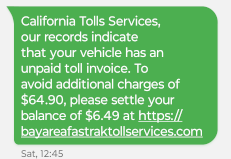
    Did you get a text saying “California Tolls Services, our records indicate that your vehicle has an unpaid toll invoice. To avoid additional charges of $64.90, please settle your balance of $6.49 at https://bayareafastraktollservices.com”?   Be careful – it is a scam!

    Cash-free, electronic toll collection is commonplace on bridges and toll roads across California and the nation. This shift has created a new type of fraud. Cybersecurity experts call it “smishing,” phishing perpetrated through SMS text messages. The template is simple: Scammers posing as toll road operators Like Bay Area FasTrak claim the recipient owes money, and provide a link to a fake website.FasTrk scam smishing

    From the beginning of March to April 12, the FBI’s internet crime complaint center received more than 2,000 reports of texts from impostor road toll collection services nationwide. Written in “almost identical language,” these texts requested payment for outstanding toll debts in similar amounts, spokespeople for the bureau said in a statement.

    If (and when) you receive one of these smishing messages, simply delete it. If you have unfortunately fallen into the scam, contact your bank or credit card company right away and report the charges.

    FasTrak — the Bay Area’s road and bridge toll collector — does not keep people’s mobile numbers or communicate by text. Drivers with FasTrak accounts pay tolls electronically via transponders mounted on their windshields, or photographs snapped of their license plates as they pass through a toll lane. People without accounts receive invoices in the mail after cameras capture their license plates.

    You can read more about smishing and the steps you can take to avoid getting scammed at the FCC’s web page on how to Avoid the Temptation of Smishing Scams.

    Interested in learning how you improve your cyber-hygiene?? We can help! Our blog post Cybersecurity for Employees: Awareness Can Save You from a Breach is full of tips, and our Zero Trust Security Checklist will get you started.

  • Debunking Myths About AI in Cybersecurity

    AI has become a buzzword that often evokes a mix of awe, doubt and even fear, especially when it comes to cybersecurity. However, the fact is that if used effectively AI can revolutionize the way businesses like yours operate.

    That’s why you must cut through the noise and separate fact from fiction if you want to leverage AI effectively. In this blog, we’ll debunk some common misconceptions about AI in cybersecurity.

    Let’s dive in.

    AI in cybersecurity: Fact from fiction

    There’s a lot of misinformation surrounding AI in cybersecurity. Let’s dispel some of these common AI myths:

    Myth: AI is the cybersecurity silver bullet
    Fact: AI isn’t a one-size-fits-all solution for cybersecurity. While it can efficiently analyze data and detect threats, it’s not an easy fix for everything. You can use AI security solutions as part of a multi-pronged cybersecurity strategy to automate tasks, pinpoint complex threats and assist your IT security professionals.

    Myth: AI makes your business invincible
    Fact: Cybercriminals are always finding new ways to exploit your IT systems, and it’s only a matter of time before they discover ways to breach AI solutions as well. AI alone can’t protect your business. Think of AI as a top-notch security system that is made better through regular vulnerability updates and staff education.

    Myth: AI is a perfect tool and always knows what it’s doing
    Fact: Don’t trust all the marketing gimmicks around AI. Yes, AI security is indeed a “super cool” tool. But keep in mind that AI is still an evolving technology, and there’s much to be perfected. Some companies make loud claims about their AI security tools. An honest vendor, however, will tell you that AI is not magic. If you give it time, AI can learn and adapt on its own.

    Myth: AI does everything on its own
    Fact: AI doesn’t fly solo! While AI is great at sniffing out suspicious activities, it still requires human intervention. You can set the goals for AI, analyze what it finds and make the final call on security decisions. There are also times when AI can sound the alarm for no reason; that’s when you need the expertise of your security team to say, “False alarm!”

    Myth: AI is for big companies with deep pockets
    Fact: AI security solutions are now within reach for businesses of all sizes as they are becoming more affordable and easier to use. Moreover, the availability of cloud-based AI solutions means that businesses, regardless of their size, can leverage AI without breaking the bank.

    Empower your cybersecurity

    Fortify your business with the help of AI-powered cybersecurity solutions. Don’t do it alone. Get some expert help. Partner with an experienced IT service provider like us. Our IT experts can assist you in understanding your security needs, finding the perfect AI solutions for your business and ensuring they’re implemented effectively.

    Contact us today for a free consultation and learn how we can keep your business safe in the digital age.
  • How Cybercriminals Use AI to Power Their Attacks

    Managing a business on your own is challenging enough without worrying about cyberattacks. However, there is cause for alarm as hackers are using artificial intelligence (AI) to launch sophisticated cyberattacks to steal your data and disrupt business operations.

    The good news is there are steps you can take to protect your business. This blog will explain how AI is being used in cybercrime and how you can safeguard your business.

    How hackers use AI

    Here are some of the ways cybercriminals are exploiting AI:

    Deepfakes: Hackers use AI to create highly realistic fake videos or audio recordings to impersonate someone you know, like your boss or a trusted friend. These deepfakes can be used to trick you into sending money or sharing sensitive information.

    How to spot it: Closely look for details like unnatural facial movements or sloppy voice synchronization.

    AI-powered password cracking: With the help of AI, cybercriminals can effortlessly crack common and easy passwords. Hackers with access to advanced computation offered by AI can automate the breaching process, so they can try millions of combinations to guess your password.

    How to fight back: Always use unique passwords. Consider using a password manager.

    AI-assisted hacking: Hackers no longer have to spend hours looking for vulnerabilities. Instead, with the help of AI, they can create automated programs that not only identify weaknesses in your system but also create new types of malware.

    How to stay ahead: Keep your security systems and software updated. Also, a mandate should be set up to scan for vulnerabilities routinely.

    Supply chain attacks: Threat actors use AI to insert malicious code into legitimate vendor products, which eventually will compromise your system as well.

    How to protect yourself: Only download software from trusted sources. Always be vigilant with updates and patches.

    Boost your defenses

    AI-powered cybercrime is a growing threat. That’s why having a strong IT partner by your side can be the ultimate weapon in your arsenal. Partner with us to leverage advanced technology to fortify your defenses.

    Reach out to us today for a free consultation and learn how our team can secure your business against evolving cyber risks.

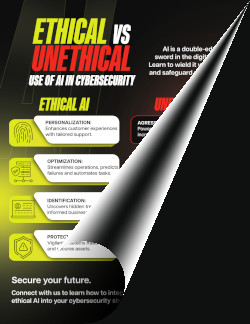
    AI is still a new technology, and to many businesses, it may feel like uncharted territory. That’s why we’ve created this free infographic that will shed light on how AI can be used both ethically and unethically.


      NTELogic has permission to contact me at the email address provided: YesNo

    • The Most Dangerous Myths About Cloud Data Backup

      For businesses, Software-as-a-Service (SaaS) solutions offer unparalleled opportunities to enhance efficiency, scalability and overall operations. However, growing SaaS backup-related misconceptions also have the potential to hurt your business growth.

      In this blog, we’ll shed light on some SaaS-related truths you simply cannot afford to ignore. Let’s dive in.

      Don’t let these myths put your business at risk

      Myth 1: My SaaS solution is completely secure.
      While leading SaaS solutions like Office 365, G Suite and Salesforce do offer top-of-the-line security along with robust recovery features, the truth is that they aren’t completely foolproof against all threats. They can’t protect your business data from malicious insiders, accidental deletions or hackers.

      Solution: By regularly backing up your cloud data, you can protect it against a wide range of threats and unforeseen disasters.

      Myth 2: My SaaS provider is solely responsible for my data security.
      There is a widely held misconception that your SaaS provider is solely responsible for protecting your cloud data. The truth, however, is more nuanced. While a provider is expected to implement robust security to protect your data, businesses also are expected to play an active role.

      Solution: Proactive steps like training your employees on data security best practices and implementing access control steps can ensure your data remains secure in the cloud.

      Myth 3: My SaaS provider’s backup is all I need.
      While some of the top SaaS providers offer features such as Recycle Bins and Vaults that can store accidentally deleted files, these solutions have limitations and don’t offer comprehensive backup and recovery.

      Solution: Consider taking the help of an experienced IT service provider who can not only securely back up your data but also help you enhance your cloud security.

      Elevate your data security with a strategic partnership

      Ready to empower your business with an advanced backup and recovery strategy? Partner with an IT service provider like us to build a comprehensive SaaS backup and recovery strategy that suits your business needs.

      Let data recovery be the last of your worries! Contact us today for a free consultation and learn how our IT team can be your strategic partner.